

The Campsite
For the first time, we will be revisiting a prior campsite, as we will return to Hedeland Naturpark, which hosted Jamboree Denmark 2022.
The campsite for the Jamboree
For the first time, we will be revisiting a prior campsite, as we will return to Hedeland Naturpark, which hosted Jamboree Denmark 2022. The site will not be a copy of the last jamboree, as the the gravel excavation of the site is ongoing. But there will still be four subcamps, but their location and names have changed.
The names of the subcamps are Skoven (the forrest), Byen (the city), Landet (the countryside) and Havet (the sea). The international groups can be hosted by local friendship groups.
Practical information about camplife
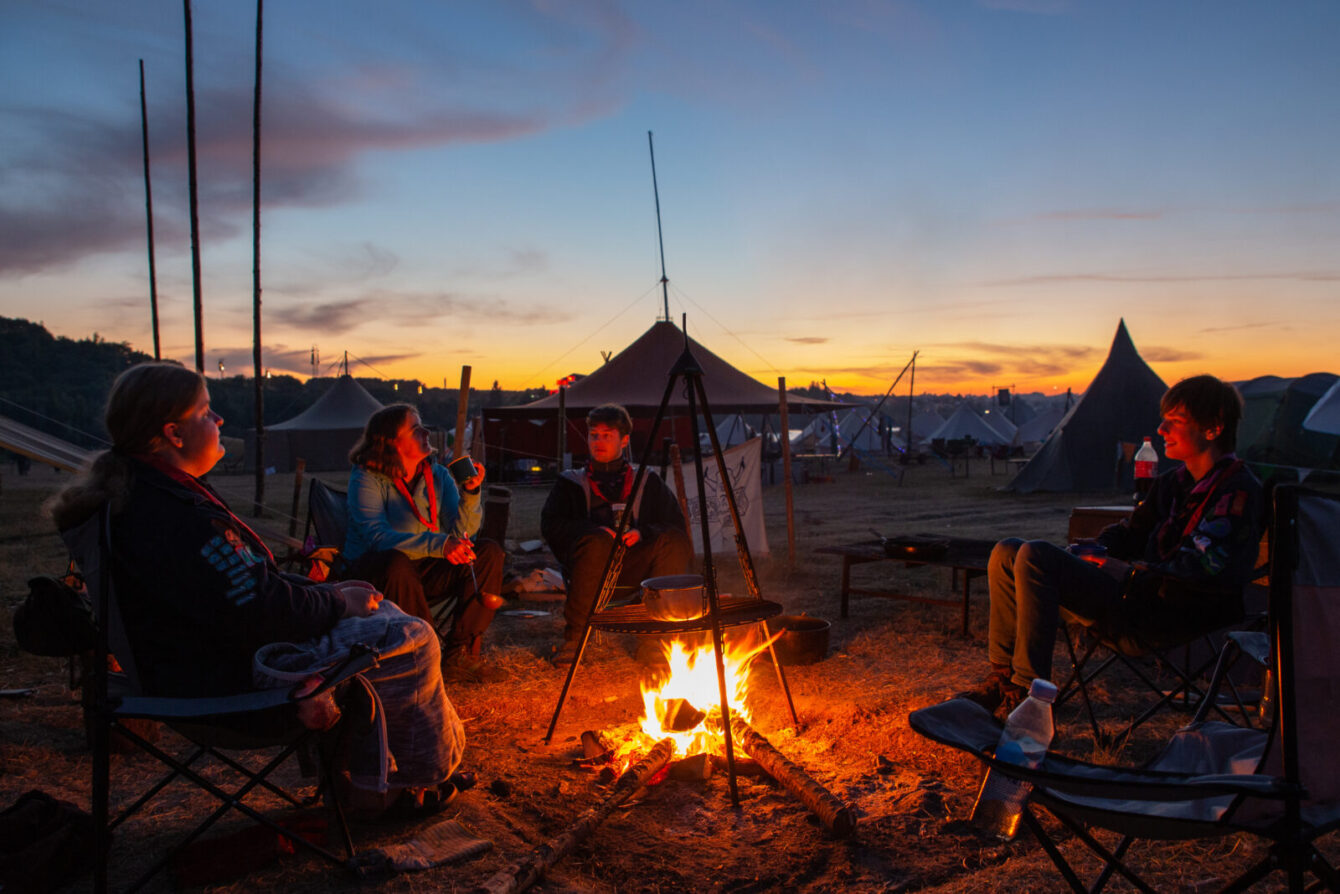
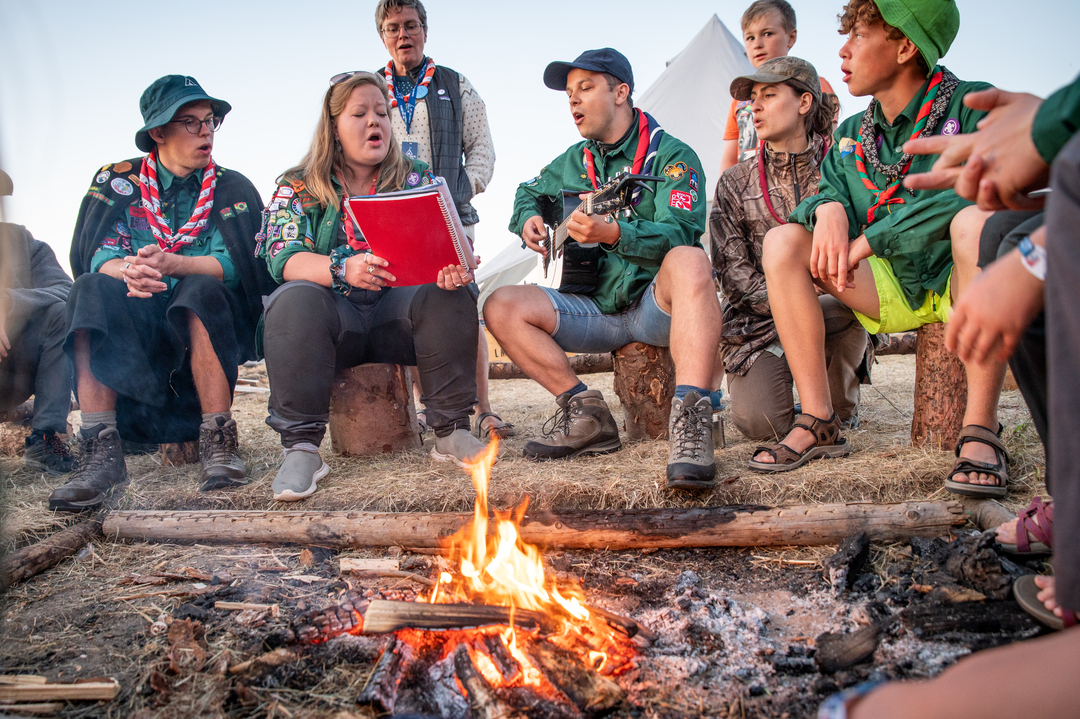
The campsites are a temporary home for the groups at Jamboree Denmark 2026. You can plan your campsite as it fits best for you and this is where you will prepare food for your group during the week.
To ensure that the jamboree lives up to official safety regulation, there will be guidelines for larger structures. They can be found on this page once they are ready.

Information and Guidelines for the Group’s Campsite
Charging your group’s electronic devices
It is possible to charge electronic devices in all four subcamps, where one charging container will be set up in each subcamp. Here the group can return a box with the items that need charging and collect the box the next morning. The box must have a cable with a 230V plug (plug type C) so that it can be plugged directly into a socket in the container. Remember to write the group’s name on the box.
Opening hours are 7 AM – 9 AM and 4PM – 7PM.
Charging stations at the jamboree
In addition, eight charging stations with power banks will be set up around the jamboree, offering various charging options for a fee. The location of the machines will appear on the jamboree map in the jamboree app.
In the webshop, you can buy a subscription that gives you two hours of charging (power bank) every day throughout the entire jamboree for a total of 200 DKK.
In addition, you can purchase 30 minutes of charging from a power bank using a QR code displayed on the machine. It costs 25 DKK. The power bank can be returned to any machine when the time has expired. If you do not return the power bank on time, an additional 25 DKK per per half hour. However, a maximum of 100 DKK per day. If the power bank is not returned to a machine at all, an additional fee of 175 DKK will be charged.
If there is no free space in a machine when you return it, contact the company, which will ensure that you are not charged a fee. The company’s contact details are written on the machines.
Note. It is not possible to charge your own power banks in the machines. You can charge these in the group’s box in the charging containers, as described above.
Electricity at the Campsites
Electricity can only be ordered at the campsites for medical equipment. This ordering takes place through group registration. Electrical connections will be run as far as the municipal boundary. The location is arranged directly between the subcamp technology team and the municipal coordinator. Users are responsible for installing approved cables in their own sections.
First Aid on the Campsite
Most minor injuries should be dealt with on the campsite, and each group is expected to bring suitable first aid equipment.
A first aid kit for treating minor cuts and injuries may usefully contain the following:
- Tap water in a container or bottle, if there is no access to running water.
- Soap
- Kitchen roll for washing and drying
- Regular plasters (preferably in several sizes)
- Blister plasters
- Tweezers
Garbage and Recycling
The Jamboree’s Recycling Contractor
The Jamboree Denmark 2026 recycling team has chosen Remondis as the jamboree’s recycling contractor. Remondis was also the recycling contractor at Jamboree Denmark in 2022, which means that, in collaboration with them, we can build on the experience from the last jamboree.
Together with Remondis, we will make it easy to return and sort your recycling and garbage, so that we can create more sustainable recycling and garbage management at the jamboree.
Sorting Categories
All campsites must sort garbage into eight different categories, as it is also done in the rest of Denmark These categories follow the national categories.
The eight categories are:
- Food garbage
- Glass
- Paper and cardboard
- Plastic, food and beverage cartons
- Metal
- Textile garbage
- Hazardous waste
- Residual waste
At the jamboree, a sorting guide will be included in the arrival materials. If your guides and scouts are not used to sorting garbage when you are at a jamboree, it may be a good idea to introduce them to the categories before the jamboree.
We are currently working on a sorting solution for campsites, which you can purchase for your group if you need a good garbage sorting system for your jamboree.
If your group already has a system that works well for you, you are of course welcome to bring this with you.
Garbage Disposal Sites and Opening Hours
Each subcamp square will have a sorting point where groups must return their garbage. Towards the end of the jamboree, this is also where you can return larger items of garbage.
Each garbage disposal site will be open during meal periods, so you can return your garbage at the same time as you collect your food.
Clear garbage bags will be available at the food distribution point.
Firefighting equipment
A fire bucket of at least 10 litres must be placed at each tent used for overnight stays. The bucket must be filled with water. If several tents are set up in a cluster (up to eight tents), the total number of fire buckets may be reduced. However, each tent cluster must always have at least three fire buckets.
A fire bucket of at least 10 litres must be placed at each campfire site. The bucket must be filled with water.
A manual water pump fire extinguisher or a pressurised water extinguisher (minimum nine kg) must be placed on the campsite. If a manual water pump fire extinguisher is used, its water tank must be full. If these are replaced with a large garden sprayer, it must be clearly marked “Brandmateriel” and supplemented with a full water container or fire bucket so that at least 10 litres of water is available.
In addition, there must be at least one fire beater (remember to teach the guides and scouts how to use these correctly).
Firefighting equipment must be placed where it is clearly visible and easily accessible.
Powder extinguishers are not allowed on the jamboree.
Gas at the Campsites
Gas can be used and stored at the campsites. Each appliance may have one gas cylinder of up to 11 kg, plus an additional spare of the same size.
Gas is available at the jamboree’s hardware store on Spejdertorvet.
Rules for putting up firefighting equipment on the group’s campsite
- A fire bucket of at least 10 litres must be placed at each sleeping tent. The bucket must be filled with water. If several tents are set up in a cluster (up to eight tents), the number of fire buckets can be reduced. However, there must be at least three fire buckets per tent cluster.
- A fire bucket of at least 10 litres must be placed at each campfire site. The bucket must be full of water.
- A manual water pump or pressurised water extinguisher (minimum nine kg) must be present at the campsite. If a manual pump is used, the water tank must be full. If replaced with a large garden sprayer, this must be clearly marked as “Fire Equipment” and supplemented with a filled water can or fire bucket, ensuring at least 10 litres of water are available.
- In addition, there must be at least one fire beater (remember to teach guides and scouts to use these correctly).
- Firefighting equipment must be placed somewhere visible and easily accessible.
- Powder extinguishers are not allowed on the jamboree.
Hygiene
Avoid stomach bugs (diarrhoea and/or vomiting) through prevention. It is important to wash your hands thoroughly with soap and running water and to use hand sanitiser afterwards before handling food.
Every visit to the toilet must end with a thorough handwash at a washbasin, using running water and soap. This can be supplemented with hand sanitiser. Hand sanitiser is not an alternative to using a washbasin – only a supplement. Avoid touching your mobile phone when visiting the toilet, as this contributes significantly to the spread of bacteria.
Layout of the groups’ campsites
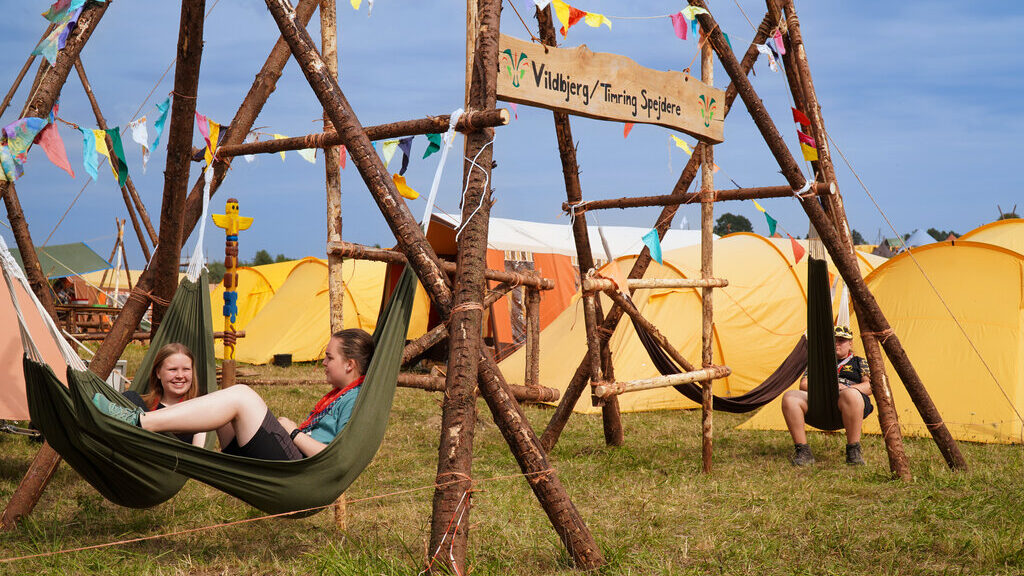
The groups’ campsites are their “homes” at Jamboree Denmark 2026. Campsites can be arranged in many different ways, depending on the size of the groups, the age sections, history, traditions and overall ideas. At the same time, much of the layout will be reused from jamboree to jamboree, for example tents, campfire sites and wooden pole structures.
We work with standardised rules for how groups can structure a campsite.
The jamboree does not wish to limit groups in their opportunities to put their own mark on their campsite, but instead wants the groups to understand what Jamboree Denmark 2026 and the authorities expect of the campsite layout.
Rules for setting up tents
Tents for overnight stays may be set up in clusters. A maximum of eight tents in each cluster.
Between tent clusters there must be at least two metres from guy line to guy line. If teepee/laavu-style tents are set up in a cluster, the distance to the surrounding clusters must be great enough that no part of the tents can hit the surrounding clusters if the teepee/laavu structure topples. However, the distance must always be at least two metres from guy line to guy line.
Rules for campfire sites
There must be at least three metres between tents and campfire sites, including elevated firepits and other campfire set-ups/gas burners. The distance must be measured from the edge of the fire pit (the inside of any edge protection of, for example wood or stone) to the nearest part of the tent (guy line, tent fabric or pole).

Showers at the jamboree
There will be an opportunity to take a shower at the jamboree. Participants must pay to take a shower, while volunteers do not pay for showers. Payment is made at the shower trailer with the Skejser wristband. Volunteers must use their volunteer wristband as an admission ticket.
The showers will be shower trailers, with individual cubicles.
The price is 20 DKK per shower.
Solar Panels and Battery Banks
Rules for Solar Panels and Battery Banks
The following guidelines apply to the use of solar panels and battery banks at Jamboree Denmark 2026. The guidelines have been prepared to prevent fires and ensure a safe jamboree for everyone.
The guidelines apply to:
- Self-built solar panel systems with associated battery banks
- Commercial solar panel systems and battery banks
- Battery banks in trailers or other mobile units
General Requirements
- Battery banks must be placed well away from all combustible materials, including tents, tarpaulins and vegetation.
- The system must not be left unattended while charging.
- Cables and connections must be properly installed and protected against mechanical damage.
- The capacity of the battery bank must not exceed what is necessary for the group’s needs at the jamboree.
Home-Built and Self-Installed Systems
Home-built systems are allowed, but the following additional requirements apply:
- The system must be correctly assembled and must not present a fire or electricity safety risk.
- Connections between solar panels and battery packs must be made correctly with appropriate fuses.
- The jamboree reserves the right to require the removal of any systems considered unsafe.
Location in Trailers
Battery banks may be installed in trailers provided that:
- The trailer is ventilated so that gas generated during charging can escape.
- There is free access to, and clear visibility of, the system.
- A CO2/water extinguisher is located immediately next to the trailer.
- The trailer is placed at a sufficient distance from tents and combustible materials.
In the Event of a Battery Fire
Fires in lithium batteries are difficult to extinguish and can flare up again. In case of fire:
- Evacuate the area immediately.
- Contact the jamboree’s control centre on tel. +45 81 112 112.
- Keep at a safe distance and let the emergency services handle the firefighting.
Questions:
If you have any questions, or are unsure about anything related to this, you can contact Alfred Lysholm Clausen and Maria Wandorf from RIGOS at: alfred.clausen@sl2026.dk and maria.wandorf@sl2026.dk
Wet Pits and waste water
Jamboree Denmark 2026 will be held in two main sections: Hedeland Nature Park and farmland east of Reerslev.
Hedeland Nature Park is a section that was previously used for gravel extraction. This means that the water now seeping down is not as well filtered before reaching the groundwater.
The area east of Reerslev has revealed many archaeological finds from the Middle Ages. Hence, the local museum is keen to minimise any excavation in this section to preserve archaeological remains from ancient houses and settlements.
It is therefore forbidden to dig wet pits. Instead, holding tanks will be used at all toilet areas in the subcamps. We recommend groups acquire transport barrels with lids for waste water.
Waste water must be transported by the group up to a couple hundred meters. Waster water barrels must be liftet up to 40 cm above ground level.
Wooden Pole Structures
Lashings on raft structures must be executed according to good Scout practice. For structures at risk of toppling over in gale-force winds (13.9 m/s and above), the load-bearing rafters must be buried or attached to strong stakes anchored in the ground.
In strong winds, any covers for dining tables and similar setups must be secured or taken down.
Wooden pole structures under four metres in height, where there is no planned occupancy above two metres (for example dining tables, entrance gateways or tripods for hanging equipment), may be built without a permit.
Approval by the Authorities
The wooden pole structures listed below, however, require approval from the authorities via the jamboree’s emergency services before the jamboree. Applications for wooden pole structures that require a permit are now closed.
- Wooden pole structures with planned occupancy at a height of over one metre, where people will be sleeping
- Wooden pole structures with planned occupancy at heights of more than two metres
- wooden pole structures exceeding four metres in height (excluding flagpoles and other single masts)
The deadline for submitting the application has been extended to March 31th 2026.
The application is prepared by completing a concept description, including a risk assessment. Drawings and any calculations must be attached. You can soon find guidance for this on this website.
Concept Description
In a concept description, you, as organisers, can outline your structure and explain what you intend to create. If you plan to construct a structure, you must also attach drawings of its design.
Risk Assessment
In a risk assessment, you evaluate what risks your structure poses to participants. For example, assess the risk of collapse and detail measures to minimise these risks, such as regular inspections.
Please note that larger structures, especially those involving overnight stays at height, might require engineering calculations, with the costs to be covered by your group.
Tents and One-pole Marquees
Tents, such as one-pole marquees larger than 100 m2 or with sides covering more than half the circumference, must also be registered with the
jamboree’s emergency services by March 31th at beredskab@sl2026.dk.
Contact
For specific questions about the approval process for building works and other spar constructions, you can write to the emergency services at
beredskab@sl2026.dk.
Municipality Allocation in the Subcamps
International groups can see which municipality they belong to by logging in to the registration system.

Nature and Archaeology in Hedeland Naturpark
In Hedeland Naturpark, you will find both wet bog and meadow areas, and small ponds, lakes and large expanses of dry grassland. Hedeland Naturpark is a large continuous natural area that gives species good opportunities to reproduce and spread. Large parts of Hedeland Naturpark are protected, and we must therefore as a community ensure that we impact it as little as possible.
In connection with Jamboree Denmark 2026, some areas are fenced off to protect particular species. There will be an information at the enclosures explaining the habitat types and species.
Clear-water Lakes – No bathing or swimming allowed here
The lakes in Hedeland Naturpark have nice, clear waters. A lot of them are directly connected to the groundwater. They are very low in nutrients, and therefore do not produce the same algae blooms as seen in many other lakes around the country. Hedeland Naturpark. The nature park’s lakes are vulnerable to disturbance, and therefore we are not allowed to bath or swim in the lakes.
Butterfly Area
The area north-west in subcamp Skoven (the forrest), near Boomerangskoven, is a breeding ground for an endangered butterfly species called “Isblåfugl” (Amanda’s blue, Polyommatus amandus). When Jamboree Denmark 2026 takes place, the butterflies will have laid their eggs on the blades of grass in the area. It is therefore important that we stay out of the area so we do not trample the eggs and make the species even more endangered.
Wild Parsnip
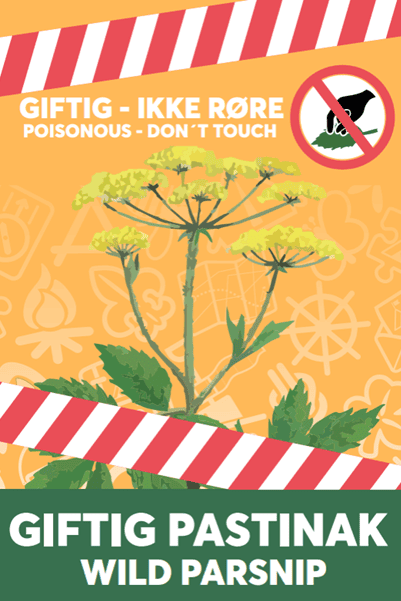
All around Hedeland Naturpark you can come across the plant wild parsnip. And even though the plant looks exciting, you should avoid contact with it.
The plant is in the hogweed family and contains a toxin. The toxin reacts when exposed to sunlight, and if it gets on the skin, there is a risk of blisters and wounds that resemble burns.
Wild parsnip is recognised by its umbels of small yellow flowers that bloom in June/July. It grows along roadsides and in open grasslands.
Wild parsnip is very distinctive and difficult to confuse with other plants. It has yellow-green flowers and yellow-green leaves. Most other wild umbel plants in Danish nature have white flowers. In July it grows approximately 75 cm tall, including the flower head.
If you get the juice on your skin, wash the area thoroughly and keep the skin covered and protected from the sun for at least 48 hours. If you develop symptoms, you can contact the Emergency clinics or the camp hospital.


